
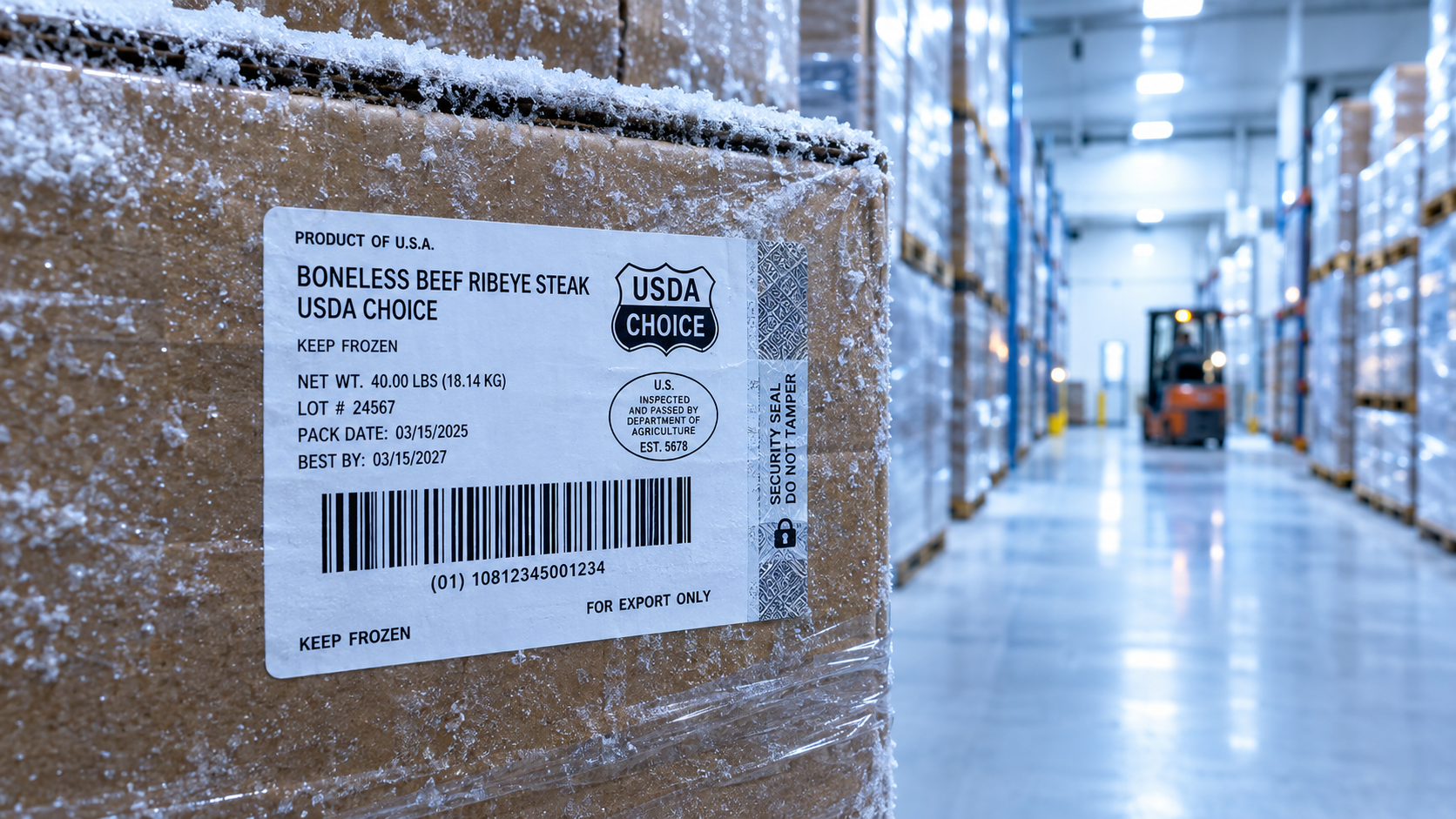
When a shipment gets rejected at the border, the instinct is to look at the product itself. The quality, the packaging, the paperwork. But more often than people realize, the culprit is something much smaller: the label. A label that peels, smears, or fails to meet USDA requirements can bring an entire export to a grinding halt, costing your operation thousands of dollars in delays, re-processing fees, and lost contracts. The good news? It's entirely preventable if you know what to look for before the shipment ever leaves your facility.
What Are USDA Export Labels and Why Do They Matter?
USDA export labels aren't just a formality. They're a federally required compliance element for any meat or food product crossing international borders. They verify the origin, contents, and handling of the product, and they give destination countries the traceability they need to accept your shipment. Without the right label, applied correctly and built to survive the journey, your product doesn't move.
For meat processors and food manufacturers, this compliance burden is particularly high. Labels must meet specific formatting and content requirements, often varying by destination country, and they must remain fully legible and intact through refrigerated and frozen transit conditions. That's a tall order for a label that wasn't designed with those demands in mind.
Where Things Go Wrong: The Most Common Reasons Exports Get Rejected
Most export label failures come down to a handful of recurring problems.
The first and most common is adhesive failure. Standard labels aren't built for cold chain environments. Freezing temperatures, condensation, and temperature swings during transit cause the adhesive to break down, and once a label starts to peel, it's a compliance issue whether the product is still in your warehouse or already on a truck headed to port.
The second is missing or incorrect compliance information. USDA export labels must include specific data points, and depending on where your product is going, destination countries may have their own additional requirements layered on top. A label that works for one market may not be approved for another.
Third is print quality. Barcodes that won't scan and text that's unreadable under cold or wet conditions create real problems at inspection. If a label can't be read, it's treated as non-compliant, full stop.
Finally, there's the supplier problem. Not every label printer is equipped to produce USDA-certified export labels. Working with a supplier that isn't approved or doesn't understand the regulatory landscape puts your entire shipment at risk before it even gets loaded.
Why the Adhesive Is More Important Than Most People Think
Here's something that surprises a lot of operators: the adhesive on your label matters just as much as what's printed on it. Maybe more.
Cold chain logistics are brutal on labels. Products move from processing floors to walk-in freezers to refrigerated trucks to shipping containers, often experiencing significant temperature swings along the way. Add in condensation from packaging, moisture in the air, and the rough handling of freight, and you start to understand why a standard pressure-sensitive adhesive simply won't cut it.
This is exactly what Arctic Bond was designed to solve. Beyond Print's Arctic Bond labels have been thoroughly field-tested and are USDA/IARW approved, built specifically to perform in extreme environments, withstand freezer temperatures, and adhere reliably to any box. Beyond Print is also a leading export label supplier to the International Association of Refrigerated Warehouses (IARW) in North America, which means these labels aren't just tested in a lab. They've been proven in the real-world conditions your products actually face.
When an adhesive fails at the port or during inspection, you're not just dealing with a rejected shipment. You're dealing with a damaged relationship with your buyer and a potential compliance flag that follows your operation.
What to Look for in a USDA Export Label Partner
Choosing the right label supplier for export products isn't the same as ordering standard labels for your domestic line. Here's what should be on your checklist:
Certification and compliance expertise. Your supplier should know USDA export requirements inside and out and be able to guide you through destination-country-specific needs. This isn't something to figure out on the fly.
Proven adhesive performance in cold chain conditions. Ask whether their labels have been field-tested in freezer environments. "Cold storage capable" and "USDA/IARW approved" are not the same thing.
Tamper-proof security features. Beyond Print's export labels include a tamper-proof security element, which is increasingly important for international trade compliance and cargo integrity.
Experience in your industry. For meat processors specifically, it's worth working with a partner that understands the full picture, including meat processing tags for livestock and carcass identification on the front end of your operation. Beyond Print offers head tags, four-part carcass tags, and no-fastener tags, and works directly with farmers and logistics managers to make sure operations run efficiently while staying FDA-compliant. A supplier that understands your operation from processing floor to export container is a different kind of partner than one that just prints labels.
Getting It Right the First Time: A Pre-Shipment Checklist
Before your next export shipment goes out, run through these checkpoints:
-
Are your labels USDA/IARW approved and sourced from a certified supplier?
-
Has the adhesive been tested for the specific cold chain conditions your product will experience?
-
Does the label meet the compliance requirements of your destination country, not just domestic standards?
-
Is the print quality sharp enough for barcode scanning and visual inspection under cold or wet conditions?
-
Does your label include a tamper-proof security element?
-
Are your meat processing tags and identification systems compliant with FDA regulations throughout the full chain of custody?
If you can't confidently answer yes to every one of those, it's time to have a conversation with your label supplier.
The Bottom Line
A rejected export isn't just a delay. It's lost revenue, a strained buyer relationship, and a reputational hit that can be hard to recover from. The cost of getting your labels right is a fraction of what a single rejected shipment will run you.
Beyond Print has spent over a decade helping meat processors, food manufacturers, and exporters avoid exactly these situations. With USDA/IARW-approved Arctic Bond labels, a full range of meat processing tags, and deep expertise in export compliance, Beyond Print is the kind of partner that helps you ship with confidence the first time and every time after that.
Ready to make sure your labels are export-ready? Connect with us here and let's talk through what your operation needs!